Overcoming Doubts and Fears in Your Spiritual Journey

Questing takes all shapes and forms. This last weekend, I took my wife and daughter on a 127-mile bike backing trip. We have been preparing for weeks, starting with small, twenty-mile rides and two weekends ago, completing a fifty – three-mile ride. I am a huge fan of doing hard things and I have written on both doing hard things and the spiritual practice of questing. https://www.patheos.com/blogs/loveopensdoors/2024/06/questing-three-days-on-the-appalachian-trail/ and  https://www.spiritualityandpractice.com/practices/alphabet/view/27/questing  

my brave and ambitious daughter

Going into the weekend, I have been watching the weather all week, the East Coast was slated for a significant heat wave with temperatures in the 100’s. I am fairly confident in my skill set to keep people safe and alive at these temperatures, but still, I was anxious. We have been training for a couple of weeks in high heat and high heat indexes and practicing taking in a lot of fluid in large boluses. The thunderstorms that had been predicted on and off never materialized.   

We had a saying in the military, poor planning equals poor performance. With my standard operating procedure set and my PACE plan planned, we began our journey. For the entire weekend, we had type I fun. There was a small moment on day 2 when my wife began to experience some Type II fun. The heat and humidity as long as we stayed cameled up never rose to type III fun, though the potentiality was there.  

Day 1: The Journey Commences

July 18 – Drive and Stage – Home, Albion, Pa to Shuttle from Harper’s Ferry WVA to Cumberland MD 

Up at the butt crack of dawn, my wife and I assembled in our kitchen and prepared a breakfast of french toast, sausage and fruit. We woke up our daughter and after eating together, assembled the last few items we needed to pack in the van and we got on our way. The drive to Harper’s Ferry was uneventful and we met our shuttle driver, Will from Wheelzup Adventures ( https://www.wheelzupadventures.com/ ) out of Cumberland, MD to take us to Cumberland where were lodging and staging for the beginning of our ride. If you ever attempt this ride, I would give a solid positive to this group, they did a great job handling our logistics. We would arrive at our lodging, 9 Decatur Guest House where I stayed in 2022 when I did the Great Allegheny Passage/ C and O thru bike then. We had dinner at the Crabby Pig, another fine eating establishment in Cumberland.  

9 Decatur Guest House http://www.9decaturguesthouse.com/ 

Crabby Pig https://www.crabbypig.com/ 

Day 2 : The Questing Gets Underway

July 19 – Cumberland, Maryland to Hancock, MD 

When I went through in 2022, my host at 9 Decatur Guest House Gale was sick with COVID so I did not get to experience her legendary breakfast, but this year, we were not disappointed. After a filling breakfast, we gathered our equipment and assembled our bikes, and we took off for the first leg of our journey. This trip, I built in difficulty for my daughter by planning the first day to be a long day. We had talked the night prior and a couple of days before the ride about possibly doing this ride in two instead of three days. The current plan was to do 60 miles then two 30-mile days.  

We covered the first 30 miles with ease and arrived at Paw Paw tunnel around 12 where we stopped for lunch. It was at this point, that my daughter said she was confident that she could do this ride in two days and tentatively, our plans changed. I told everyone that the easy part of the day was over and the next 30 miles would be work miles with not only fatigue in our legs, but the heat index would be rising throughout the afternoon.  

This first section of the C and O and for much of the section leading into Hancock, MD is largely a cow path with small sections of smooth gravel. This year, it was dry, and the potholes were not as bad, though, one should have some decent riding skills to be able to handle a bike loaded with around 30 lbs of gear and avoid potholes to navigate this successfully.  

https://en.wikipedia.org/wiki/Paw_Paw_Tunnel

Paw Paw tunnel

After lunch, we filled our water, cameled up one more time and took off for the afternoon leg, 30 miles, stopping every 10 or so miles to camel up and eat. The afternoon flew by and soon, we arrived at the C and O bunkhouse, paid our nightly fee and set up camp for the night. The C and O bunkhouse is also called the chicken coop and is essentially a bunkhouse covered with screen. It is basic, but has electric, a refrigerator and is within walking distance of several restaurants. Dinner on Friday was at Buddy Lou’s. ( https://www.buddylous.com/

Day 3: Questing – Let’s Go all the Way

July 20- Hancock, MD to Harpers Ferry, WVA 
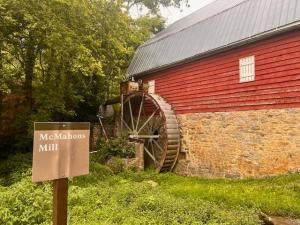
After further deliberations the night prior, we decided to go for the full 66 miles today and make this a two day journey. I honestly was quite anxious about this, neither my wife or my daughter had ever rode these distances before and we already had 61 miles under our belts. The weather today was favorable, with more cloud cover. Increased cloud cover can be good as it shields you from the direct sun, but sometimes, it means more humidity. The plan was the same today, get through the first 30 – 40 by lunch, then stop every 10 miles after for water and food in the afternoon. (we actually stopped every 10 miles on average throughout the ride).  

Like yesterday, the morning flew by, and we crushed the first 30 miles before lunch. We would stop, eat lunch, drink a significant amount of water and electrolyte, and got after the afternoon portion. In due time, we were down to single digits and then we were at the foot bridge leading into Harper’s Ferry and after a long hill climb, we arrived at our van and hotel and Sarah hit the stop button on my bike computer, officially ending our ride. 

We did it, 127 miles in two days.  
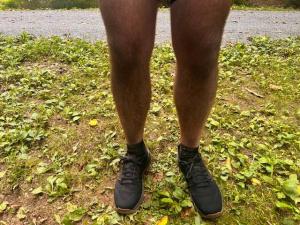
My legs were dirty!

Day 4: The Journey Ends

July 21- Harpers Ferry WVA – to home, Albion, Pa 

We were quite dirty by the time we got to Harper’s Ferry. I was especially dirty; my legs were black. After a nice shower and a clean set of clothes, we went after some dinner. Dinner completed, we retired to our beds for some reading and much needed sleep. On Sunday, we arose, had a hotel breakfast, did some sightseeing around Harper’s Ferry and took off for home, arriving home around 1630.  

The Practice of Questing 

While it may not seem like a spiritual journey, it was a spiritual practice. Trusting my skill set, listening to my wife and daughter, and keeping an eye on their safety made this a fun experience, but also one that was fraught with stress. Two weeks ago, there were several deaths in the Grand Canyon due to heat injuries and the week of this trip, temperatures were in the triple digits in the area we were operating in. Both my wife and daughter had never done these distances in this short amount of time before and other injuries were on my mind, specifically heat stroke and rhabdomyolysis. There was a lot of noise in my head going into this event. But that is the journey of the quest. Trusting the experience, not clinging to an outcome, and letting problems arise as they do and addressing them with a clear mind. Clinging is the source of suffering and clinging to a should or an outcome only sours the experience.  

Jesus went to the desert to clear his head. The world’s monastics have all used isolated places to go to clear their heads. The natives in America used quests to clarify their purposes and aims. Hopefully, as my daughter grows and faces the many challenges she will face, she will look back on this experience and see that all her problems must be taken one pedal stroke at a time and reevaluate the plan often, ready, and willing to make changes as situations arise.  

Living in Alignment with Your True Self 


What is a True Self 

I have been thinking about one’s true self lately. The contemplative teachers Richard Rohr and Joan Chittester have both devoted recent posts and meditations on this topic. Chittester has devoted the whole month of July to this topic in her Monastic Way ( https://joanchittister.org/content/newsletters/monastic-way/current-issue ) I recently wrote a post around Thich Nhat Hahn’s book “Peace with Every Step” ( https://www.patheos.com/blogs/loveopensdoors/2024/07/is-peace-achievable-in-todays-society/ ). Returning briefly back to this book, I want to reflect on Hahn’s thoughts regarding flower insight. On page 43 of his book, Hahn offers “That is the problem of life. If we are not fully ourselves, truly in the present moment, we miss everything” (Hahn, 1991, pg. 43). Later in this section, he offers this poem (Hahn, 1991, pg 44): 

Standing quietly by the fence, 

You smile your wonderous smile. 

I am speechless, and my senses are filled 

By the sounds of your beautiful song, 

Beginningless and endless. 

I bow deeply to you. 

In this post, I want to challenge the notion of original sin and focus on original goodness. In the poem above, we read “I bow deeply to you.” In Pali, the word is Namaste. The presence of the divine in me bows to the presence of the divine in you. Whether we are talking about one’s Buddha nature or one’s Christ nature, in all of us is the divine presence. God said it was good, it is good, and we all possess this goodness regardless of what our life, our religious orientation or own internal dialogue says. You are good, you are love and I bow in compassion to your beauty.  

Here 

Nostradamus aside, humans are horrible future predictors. Future predicting is a common thinking error that my clients engage in. The future is a mystery (there is a spiritual practice for that!).  

The practice of contemplation places the practitioner in the now, the here. In philosophy, we will see an ongoing dialogue around being and becoming. In cultivating a healthy sense of self and understanding our true selves, cultivating a sense of being is the key practice here.  

Contemplation “helps us access our True Self, the part of us that is always connected to God. Contemplation teaches us how to live in this open place where we watch reality come and go. We learn from it and let it change us (Rohr, 2016). 

Being here now means showing up and sitting with ourselves. My clients hate this and will conduct all sorts of emotional and mental gymnastics to avoid this or even change the subject. Being here now with God requires us to place our vulnerabilities at God’s feet and let God love us the way God has loved us from the beginning. Here, God bows in compassion to us and declares our goodness back to us. For many, this is an extremely uncomfortable feeling, so much of our identity can be wrapped up in warped feelings of not being enough, not loved enough or alone. With God, you are always enough, you are never alone.  

Becoming 

Many of my clients come to me because at some point, they were told that they could not do something, and it stuck and manifested into a pathological problem presenting as anxiety and depression. I can relate. In the 80’s, they treated ADHD much differently than they do now. I was told in high school that I was not college material and that I should consider a trade job or the military. Being a Gen X’r, I thumbed my nose at this and did it my way. While I have not been completely successful, I am here now and continuing to grow.  

Life happens with you or without you. John Lennon is often connected to the quote “Life is what happens to you when you are growing up.” One of questions I ask my clients often is, “so, what are going to do about it?” Connecting or reconnecting to your true self is a process of becoming.  

A Spiritual Practice of You 

As I was thinking about this post last week, I was thinking again how my clients often come to me depressed and anxious. Sometimes this anxiety stems from the awareness that they are good people, but internal messaging has kept them stuck believing false beliefs about themselves. Life then becomes a quest to close the circle from goodness to goodness. We begin our lives with awareness of our goodness, circumstances train this out of us and at the end, we ask the question and often struggle with the question, was it all worth it? 

The focus on you is not selfish, it is a spiritual practice. We are all on a path of discovery. We are not done with this life until it is over. Every day is a new creation, 24 new opportunities. 


Reference: 

Hahn, T. N. (1991). Peace is Every Step. Bantam Books. 

Right Here, Right Now — Center for Action and Contemplation. (n.d.). Retrieved from https://cac.org/daily-meditations/right-here-right-now/  

Rohr, R. (2016). Authentic Transformation. Albuquerque, NM: Center for Action and Contemplation. CD. No longer available.  

What Defines our Humanity?

What Shapes Our Humanity? 

What shapes our humanity? I was having a conversation the other day and this question came up. The idea I posited was that time was a human made illusion. To push this further then, I then suggested that at a basic level, we only need food, water, shelter and satisfy our primal urges to procreate. Everything else we believe we need and is human made constructs.  

The Beauty of Being Human 

I was reading about the controversy over the Muppets, Bert and Ernie the other day. For a long time, people have speculated that the two characters were gay. The creators have repeatedly denied this. Sesame Workshop insists that because the characters are puppets, they have no sexual orientation. Frank Oz, who was the original performer of Bert is quoted as saying: 

“They’re not, of course, a gay couple. But why that question? Does it really matter? Why the need to define people as only gay? There’s much more to a human being than just straightness or gayness. (this quote can be found in articles in Time Magazine, Business Insider and Washington Post, among others) 

Fearfully and wonderfully made. As the story goes, after God got done creating everything, not only did God declare the creations good, but very good. A few weeks ago, I wrote this post on non duality: https://www.patheos.com/blogs/loveopensdoors/2024/06/is-non-duality-the-key-to-liberation-from-ego/ . In this post, I offered this insight, “Who we are is only a story that we tell ourselves in our head. We at any one time are someone to somebody and for many, this interconnectedness determines our financial securities, our loyalty to our tribes, our attachment to and with our children and spouses/partners.  

In the same way, we have an interconnectedness with God or the divine that again is just an illusion in our heads. Too often these days, we want to silo God into our camp and make Jesus our personal boyfriend/girlfriend. Folks, this is not high school, and this is not how mature relationships work. God cannot be siloed, and Jesus is a homeless dead Jew who died a long time ago. Our relationship with God is communal and God’s connection in my opinion is connected with all traditions and nationalities.” 

Being human is very cool, but also, overly complex. To be human, is to be born as an animal in the genus homo sapiens. Who we see walking around today is a long trajectory of development and evolution. Over the millenia, we have taken a very basic concept, survival and commoditized it, complicated it and weaponized it. To be human, is to go back to the basics and learn to just be. (Consider this article from Psychology Today: https://www.psychologytoday.com/us/blog/philosophy-dispatches/201205/what-does-it-mean-be-human

Considering a Queer Theology 

Considering a Queer Theology is part of understanding our humanity. Ignoring or denying LGBT issues and concerns in our church communities is like ignoring your doctor’s recommendation to eat healthier, cut the salt and move more after a diagnosis of heart disease. Ignore it long enough and it will kill you. Ignoring the contemporary issues of our day is killing our churches, supporting the rise of the nones and enabling a toxic Christianity that threatens our democracy. 

A disclaimer – I am a white heterosexual male, and I have been with the same awesome woman for 27 years. In my early days of preaching, I would have never considered writing a post or a sermon considering Queer theology. A few posts back, I talked about getting out of our comfort zone. But, if we are going to be agents of change in a Fruitcake world, then we must be willing to be uncomfortable, much in the way Jesus made Peter uncomfortable.  

Our perceptions of the world around us are based on who we are, not what things actually are. Of course, a horse is a horse, but beyond that, the rest is subjective. In the same way, how we read and interpret the bible is also subjective and this is one of many reasons I am drawn to John Wesley’s Quadrilateral as a scaffolding for our faith.  

In perusing the many articles and groups supporting Queer theology, one of the many references I came across was this, Queer people see things in the bible in ways that others would not. One of the fascinating characters that was highlighted were the many eunuchs that played various roles in biblical stories. The other character that came up was the man who carried water. A Eunuch guides Philip, however, I have only every preached on Phillip, never considering the eunuch. (See this article from Peter Toscano https://www.movement.org.uk/resources/queer-theology-101 ). In order to truly be 21st century Christians and truly live the example that Jesus put forth; we must consider all the positions about there. The Black, Feminine, Womanist, Latinx and the Queer (I am sure I missed a few).  

 The Spiritual Practice of You – Embracing Your Humanity 

No matter how you identify, YOU ARE LOVED. Hard stop. God cultivated and created the emotion of love for all of us to enjoy. To further this, God created you to be a free agent to love who you want to love. Love is not bound by human made constructs. Love (lust really) is a primal instinct, which starts out lustfully, but also starts, blooms, and matures into friendship.  

To borrow a lengthy piece from Erica Liu: 

Queer people reflect the infinite diversity of God’s image – a God who surpasses all human attempts to summarize and encapsulate. 

In Genesis 1, God transcends binaries even as God creates them: day/night, land/sea, heaven/earth. God is in all things. We know Creation is not limited to a black-and-white binary of day/night and land/sea: we see infinite (and beautiful!) variation in sunrises and dusks, beaches and rivers, etc. We instinctively celebrate these gifts, but have clung to a rigid understanding of sex and gender, ignoring that the male/female binary is also an abbreviation of a vaster and more beautiful spectrum in the same way. Queer and trans people are the holy sunrise beaches of humankind. 

If humans are made “male and female” in God’s image, we understand that God transcends male and female, is beyond and above gender. Dare we say, God themself is queer. 

Jesus continued to transcend (or “queer”) the binaries of human/divine, life/death, clean/unclean (etc.) in his being as well as actions. 

 Our capacity to love intricately is a marker that defines our humanity. Our ability to make choices, to think deeply and critically is also a Hallmark. But it is love that is and must define us. Love alone is what brings us closer to God and Love alone is what brings us closer to each other. 

Reference: 

Kraus, Kelly (2014) “Queer Theology: Reclaiming Christianity for the LGBT Community,” e-Research: A Journal of Undergraduate Work: Vol. 2: No. 3, Article 4. Available at: http://digitalcommons.chapman.edu/e-Research/vol2/iss3/4  

Liu, E. (2020, January 20). Queer Theology – Learning from LGBTQ+ Christians. PressHouse. Retrieved June 7, 2024, from https://preshouse.org/blog/queer-theology-learning-from-lgbtq-christians/  

Girard’s Mimetic Theory and Its Relevance Today 

Rene Girard 

Rene Girard, born in 1923 and died in 2015 was a French polymath, historian, literary critic, and philosopher of social science. He would write nearly thirty books which covered many academic domains. Girard was most known for his intellectual work on desire.  

In this essay, I want to comment on two well-known components of Girard’s work, desire, and his work on the Scapegoat mechanism.  

Mimetic Desire and the Imaginary Audience 

Girard was most known for his work on mimetic desire. “Ever since Plato, students of human nature have highlighted the great mimetic capacity of human beings; that is, we are the species most apt at imitation” (IEP). Imitation is a basic mechanism of learning. In human development, we often talk about mirror neurons. These mirror neurons are essential to the interaction between parent and child at the earliest stages and are essential to learning. A child who has poor or nonexistent parental interaction becomes set up for failures in learning and social development later when they become school aged.  

In middle school, mimetic desire is on full display in a concept known as the imaginary audience. (See this post where I commented on this concept: https://www.patheos.com/blogs/loveopensdoors/2024/04/how-rousseaus-philosophy-can-teach-us-to-be-less-anxious/ ). According to Girard, most “thinking devoted to imitation pays little attention to the fact that we also imitate other people’s desires, and depending on how this happens, it may lead to conflicts and rivalries” (IEP).  

Conflict arises when in imitation, people find that they are desiring the same things. One of the questions I have been asking my students this semester in the philosophy class I am teaching, is “what is wrong with people these days?” Here, we see mimetic desire and a politically manipulative system exploiting people’s need for control and fear of scarcity.  

It is important to distinguish Girard’s ‘imitation’ from ‘mimesis’. “The former is usually understood as the positive aspect of reproducing someone else’s behavior, whereas the latter usually implies the negative aspect of rivalry. It should also be mentioned that because the former usually is understood to refer to mimicry, Girard proposes the latter term to refer to the deeper, instinctive response that humans have to each other” (IEP). 

Scapegoat Mechanism and the Implications for Atonement Theory 

I am not a fan of traditional atonement theories, and I am particularly allergic to the theory known as penal substitutionary atonement theory.  

As a summary, penal substitutionary atonement posits that (theopedia.com): 

Christ died on the cross as a substitute for sinners. God imputed the guilt of our sins to Christ, and he, in our place, bore the punishment that we deserve. This was a full payment for sins, which satisfied both the wrath and the righteousness of God, so that He could forgive sinners without compromising His own holy standard. 

I feel that this particular theory of atonement has contributed to widespread violence at the hands of Christians. I also feel that it makes Jesus a MacGuffin (see https://www.britannica.com/art/MacGuffin ). As other public theologians have called for, I echo the call for a more nonviolent atonement. Rene Girard gives us one through his scapegoat theory.  

Girard’s Scapegoat Theory 

When mimetic desire creates feelings of lack, fear of scarcity or and blaming say in the case of our current American situation, violence can ensue. For Girard, “the sacrificial victim, the scapegoat, serves as a symbolic vessel for the exorcism of collective tension and conflict. By placing the blame on this chosen entity, the community achieves a temporary sense of unity and relief. The act of scapegoating allows the community to externalize its internal conflicts onto a single target” (Deian, 2023). In America, the scapegoat is whoever either political party blames for society’s problems.  

It has been proposed that as a reason for Jesus’ death, who was an innocent Jewish man, that he went to the cross as the “last scapegoat.” In Jesus going to the cross, he put on full display the lengths the Jewish religious officials, and the Roman government would go to control the population. In his death, people’s minds were changed, and this change would begin the gradual downfall of the Roman empire, the destruction of the temple, all which Jesus predicted. In a more practical sense, Jesus as the last scapegoat demonstrated God’s solidarity with all peoples that society pushed to the margins. Those who are blamed for society’s ills. Christ’s love on the cross is a statement that there are no more scapegoats. “There is no longer Jew or Greek; there is no longer slave or free; there is no longer male and female, for all of you are one in Christ Jesus.  And if you belong to Christ, then you are Abraham’s offspring, heirs according to the promise. (Galatians 3:28-29) 

Consider this very thorough Patheos article: https://www.patheos.com/blogs/publictheology/2022/10/how-does-jesus-save-part-seven-final-scapegoat/  

Practical Applications – Mimetic Desire and a Christ Intentional Life 

I talk to so many people who do not have an intentional faith system. Too many have been turned away from Christianity because of the hypocrisy, the toxic theology and self-righteousness. All these attitudes create the opposite of mimetic desire.  

If we genuinely want people to “desire” to be part of the movement that Jesus started before his death, we must begin to embody the Christ nature that Jesus fully actualized. One of the many experiences I have found universal among my clients is the need for love. Too often, I ask, “when was the last time you were told you were loved?” Never or not recently is the common answer. When I talk about the universal love of Christ and its availability to all, many of my clients are shocked and usually ask me why this is not offered in church. The other answer I sometimes get is that I would go to your church if this were preached.  

Bonhoeffer offered that cheap grace is grace without discipleship, grace without the cross, grace without Jesus Christ.” Notice what is emphasized in Bonhoeffer’s definition of cheap grace and what is de-emphasized. The emphasis is on the benefits of Christianity without the costs involved; hence, the adjective cheap to describe it. I would add that while many churches have many of these qualities, they are led by an ignorant and often toxic theology. We must create a mimetic desire for costly grace and a theology that takes in mind the notion of the last scapegoat.  

Reference: 

Deian (2023, December 8). Unraveling the Threads of Human Desire: René Girard’s Mimetic Desire. Medium. Retrieved May 19, 2024, from https://medium.com/@deianrajovic/unraveling-the-threads-of-human-desire-ren%C3%A9-girards-mimetic-desire-2f6761dff77f  

(n.d.). Penal Substitutionary Atonement. Penal Substitutionary Atonement. Retrieved May 19, 2024, from https://www.theopedia.com/penal-substitutionary-atonement 

(n.d.). Rene Girard. Internet Encyclopedia of Philosophy: A Peer Reviewed Academic Resource. Retrieved May 19, 2024, from https://iep.utm.edu/girard/ 

Churches need more spirituality, less prescription

In a recent post on a creedal faith (https://www.patheos.com/blogs/loveopensdoors/2024/04/a-creedal-faith-after-deconstruction/ ), I offer these thoughts on deconstruction: 

We are hearing a lot of chatter and seeing a lot of literature these days concerning the act of deconstruction, especially from a faith perspective. Indeed, it seems that the number of people who identify as not religiously affiliated or “nones” is increasing.  

The idea of asking questions about our faith is not a new phenomenon nor is the idea of deconstruction. The philosopher Jaques Derrida is often linked to this modern concept.  

According to Pragati Kalive (https://www.sociologygroup.com/deconstruction-theory/

Deconstruction theory, derived from the works of philosopher Jacques Derrida, is a theory of literary analysis that opposes the assumptions of structuralism. Its primary purpose is to discern the relationship between text and meaning (Kalive, 2021) 

Deconstruction for Derrida was a means to explore the relationship between text and meaning. His work “asserts that meaning is not static and instead continually evolves and varies across time and space”. (Kalive, 2021) This is important linguistically because language is always changing and meaning also changes year to year. For example, the word gay meant something completely different in 1904 than it does in 2024. In biblical studies, contextual criticism is important, and one must consider the socio-political and historical context in which something was written. 

In this post, I want to talk about reconstruction through the lens of a faith without religion for a moment to focus on the development of a healthy spirituality.  

Early Desert Contemplatives 

In the Christian tradition, during the 4th century, common era, we saw the desert “father” (there were women too) movement. In fear of reprisal and persecution, early Christians took to the “desert” to pray and think or meditate on the scriptures. The Western order of the Benedictines and the Rule of Saint Benedict comes out of this early tradition.  

The first person attributed to the monastic dessert movement was Paul of Thebes, but it was Anthony the Great who launched the movement that became the Desert Fathers. It was believed that around 270 CE Anthony heard a Sunday sermon stating that perfection could be achieved by selling all of one’s possessions, giving the proceeds to the poor, and following Jesus. He followed the advice and made the further step of moving deep into the desert to seek complete solitude (Wikipedia – https://en.wikipedia.org/wiki/Desert_Fathers ). 

The early desert parents can teach us a lot about the importance of spirituality within religion. “Their journey into the desert was a movement toward growing intentional awareness of God’s presence and recognizing that worldly pleasures bring little long-term satisfaction. Their aim was to experience God in each moment and activity by reducing their needs and committing themselves to the discipline of regular prayer and self-inquiry.” (Valters Paintner, 2020) 

Hard Stop Affirmations 

One may read my heading of this essay and think that I have lost my religion. I have not. As I have matured in my faith, I have tended to focus on what I feel is most important in one’s faith experience, relationships and cultivating a healthy and mature spirituality.  

One can recite all the scripture passages and eloquently pray all the “just Jesus” prayers all day, but if they do not know the depth of their spiritual being, they are simply empty vessels with no cultivated awareness. Indeed, I feel we all need to have deep mystical experiences and regular spiritual awakenings to truly be alive with the Holy Spirit. It is for this reason that I never took the time to memorize scripture.  

I still affirm the Apostles and Nicene Creeds and the theologies around them, though for many of the people I talk to on most days, they could care less. It is the relationship aspect that the “nones” are looking for.  

For the Christian church today, it’s leaders need to lean into the pulse of the “nones” and the growing contingent of “spiritual but not religious” seekers among them. (See this article from The Atlantic and this article from Psychology Today  

Incorporating Spirituality into Religion 

Churches can still maintain their orthodoxy and still help seekers cultivate a deeper relationship with thier spiritual selves  

5 Ways to find a sense of spirituality within a religion 

  1. Consider the Contemplative Traditions 
  2. Consider the Mystical Traditions 
  3. Consider Pluralism 
  4. Consider Deep Ecumenism 
  5. Learn how to foster inner peace by taking time to Center Yourself 

Let’s explore these briefly.  

Every religious tradition has a contemplative and alongside of the contemplative, a mystical tradition. Here, we find seekers who dig deep into their tradition, often thinking deeply about spiritual concepts and their relationship with the divine, however the divine is perceived. Here I not only think about the Christian monastics and mystics, but notably Rumi of the Suffi tradition within Islam and Buddha of the Buddhist tradition.  

Diana Eck and Matthew Fox are the two names that come to mind when I think of pluralism and Deep Ecumenism.  

Professor Eck is the founder of the Pluralism Project at Harvard Divinity School (https://pluralism.org/dr-diana-eck ). According to the Harvard website, the Pluralism Project is “an ongoing research effort, the Pluralism Project studies and interprets religious diversity and interfaith relations in the United States”. I have taught from this project in my World Religions class and have found it to be a powerful and easily accessible bridge to learning about the different religious traditions of the world.  

Matthew Fox made us aware of the concept of deep ecumenism when he introduced the world to “One River, Many Wells: Wisdom Springing from Global Faiths” in 2004. In this text, Fox points out that “we get to the core of religion by going to the heart experience, not by dwelling on doctrines that so easily divide even within religious traditions (https://www.matthewfox.org/ ). 

To center ourselves then, sometimes means doing work outside of our faith and spiritual tradition. I am often writing on the spiritual practice of you. The spiritual practice of you sometimes starts with going to therapy and working out past hurts, worries and doubts. In a world of broken systems, meaning is not being made. People often turn externally for validation without really affirming the goodness within them. Therapy can help with this. Once one is at a place where they feel emotionally safe, then they can begin deeper learning about their spiritual selves.  

Currently, the Christian church is part of this broken system. It makes meaning by prescribing a faith that is often out of touch with the needs of the seekers who are looking for meaning. We need to consider a new theology, a new understanding of humanity and openness for exploration that cannot be found within a prescribed faith.  

Reference: 

Rohr, R. (2015, October 12). The Two Halves of Life. Retrieved April 28, 2024, from https://cac.org/daily-meditations/two-halves-life-2015-10-12/  

Valters Paintner, C. (2020, January 31). The desert mothers and fathers showed all life is sacred. The Center for Action and Contemplation. Retrieved April 29, 2024, from https://uscatholic.org/articles/202001/discover-the-sacredness-of-life-with-the-desert-mothers-and-fathers/