They say you are what you eat. I eat a lot of chicken; I am not a chicken yet.
I began utilizing diet to manage my Attention Deficit Hyperactivity Disorder (ADHD) in the 1980’s when I was a little boy. At that time, my mother was introduced to the Feingold Diet and for several years, I ate a lot of foods that did not have red food dye, salicylates and had to eat carob chocolate instead of real chocolate. It was a bleak existence gastronomically speaking. From seventh grade until my early 30’s, I used some version of diet to manage ADHD symptoms. In my 30’s, I briefly went on Stratera to manage ADHD symptoms while going through my second Master’s program.
In 2010, I took up ultra distance running on a whim, thinking I ran in the Army, how much harder could it be? It turned out to be much harder than I anticipated. Today, I work about 50 hours a week and train anywhere from 7-12 hours a week for a season of endurance and ultra endurance events that lasts roughly 9 months. I keep it all together with diet and adequate sleep. In case you are wondering, I am just below average in my endeavors, and I am fine with that.
In 2024, there is adequate and abundant information regarding the impact of food and your health and now, mental health. As a place to launch from, check out this Patheos article from July 4, 2023, from Misheal Austin Witty: Happy Plate, Happy Mind: How To Improve Your Mood With Food. It is felt that this gives a very succinct understanding of the many ideas I offer to my clients when considering dietary changes vs. taking medication.
Food As Medicine
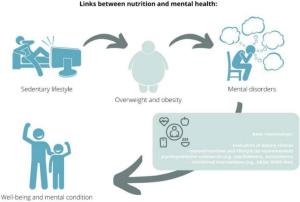
In my practice as a therapist, I have had clients come to me for years for weight related issues. Outside of the physical problems one may experience, join pain, metabolic disease and skin conditions, a person’s mental health suffers. What begins with “I should lose weight” becomes a vicious cycle of disgust, disappointment and finally despair. Medicines are thrown at the problem of the subsequent depression and anxiety, and still the person does not get better.
In a 2022 Article in Frontiers in Nutrition, a meta-analysis looked at the correlations between diet and mental health by examining 3,473 records, from which 356 sources related addressing these three questions:
- Are there correlations between nutrition and mental health?
- Are there psychoprotective food ingredients?
- Are there nutritional interventions with proven preventive potential for mental disorders?
This article pointed to how the relationship between “nutrition and patients’ mental status has been underappreciated, as evidenced by the lack of research conducted before the 21st century in this area of knowledge – cited in this review” (Gajek, et. al, 2022). The conclusion showed how this article pointed to how this trend has been reversed through increase research in psychodiettics. Through this research, correlation has been demonstrated between eating habits and one’s psychological status. This article stressed that we need to explore these correlations to create “potential opportunities to implement new effective dietary, pharmacological, therapeutic, and above all preventive interventions” (Gajek, et. al, 2022).
Nutritional Psychiatry
An emerging approach to psychiatry is incorporating the use of dietary changes to better mental health outcomes. This is a practice I was turned on to years ago when I stumbled onto how gluten can impact one’s mental health. This coincided with some behavioral issues my one daughter was having at the time. After eliminating soy from her diet and seeing modest changes, we eliminated gluten and saw everything behavioral wise take a turn for the better. These changes included decreased aggression and overall improved preschool markers that signified her readiness for grade school.
Comparing the brain and body to a car, Dr. Selhub of Harvard University suggests that what you put into your body determines how your engine runs. This is something I tell my clients all the time, especially when we are considering medications.
Dr. Selhub (Selhub, 2022) offers:
If substances from “low-premium” fuel (such as what you get from processed or refined foods) get to the brain, it has little ability to get rid of them. Diets high in refined sugars, for example, are harmful to the brain. In addition to worsening your body’s regulation of insulin, they also promote inflammation and oxidative stress. Multiple studies have found a correlation between a diet high in refined sugars and impaired brain function — and even a worsening of symptoms of mood disorders, such as depression.
It makes sense. If your brain is deprived of good-quality nutrition, or if free radicals or damaging inflammatory cells are circulating within the brain’s enclosed space, further contributing to brain tissue injury, consequences are to be expected. What’s interesting is that for many years, the medical field did not fully acknowledge the connection between mood and food.
Before you consider a medication for your mood, depression or anxiety, consider first what you are putting into your mouth. Slight changes over several months can lead to significant changes in mood and if you add movement like 45 minutes a day of moderate intensity exercise, changes in body composition.
Eating Meditation
Eating better sometimes starts with learning how to eat mindfully. I want to share this well-known eating meditation from Thich Nhat Hanh:
In Plum Village, we have a contemplation we recite before we begin to eat:
- This food is a gift of the earth, the sky, numerous living beings, and much hard and loving work.
- May we eat with mindfulness and gratitude so as to be worthy to receive this food.
- May we recognise and transform unwholesome mental formations, especially our greed and learn to eat with moderation
- May we keep our compassion alive by eating in such a way that reduces the suffering of living beings, stops contributing to climate change, and heals and preserves our precious planet.
- We accept this food so that we may nurture our brotherhood and sisterhood, build our Sangha, and realise our ideal of serving all living beings.
We tend to eat a little more slowly, to allow us to really savor every mouthful. We train ourselves to chew each bite at least thirty times, to allow us to really slow down and encounter the food, without rushing to swallow. When we can do this, we have a chance to touch peace and freedom right in the present moment. Many of us like to put down our cutlery between mouthfuls, to allow our hands to relax and to not race forward to the next bite while we still have food in our mouth.
Reference
Grajek, M., Krupa-Kotara, K., Białek-Dratwa, A., Sobczyk, K., Grot, M., Kowalski, O., & Staśkiewicz, W. (2022). Nutrition and mental health: A review of current knowledge about the impact of diet on mental health. Frontiers in nutrition, 9, 943998. https://doi.org/10.3389/fnut.2022.943998
Selhub, E., MD (2022, September 18). Nutritional psychiatry: Your brain on food. Harvard Health Publishing. Retrieved February 3, 2024, from https://www.health.harvard.edu/blog/nutritional-psychiatry-your-brain-on-food-201511168626
 Shalem Consulting